Sunday, 13 November 2011

Nanosatellites

        Over the past few weeks I have discussed the transit technique and how it is used to locate exoplanets. I have looked at that the concept of transits and the different light curves that can form. Last week I discussed the complex light curves that can arise when there are binary systems.  There is a prototype of a satellite that well be focused on finding Earth sized planets around sun like stars. These satellites are small and can range from 1 to 10kg and are made of four components. The prototype of the satellite is shown in the figure below.
        When the satellites are put into orbit around the Earth they will be concentrating their lenses at the brightest stars in the sky. Their hope is to be able to get light curves from planets that orbit around these stars. These satellites will get into their orbits by being piggybacked by space crafts. The CubeSats are confined to orbits that are low the Earth because there is no propulsion systems that are available that would fit into this small scale. There has not been a launch of these satellites yet but they are supposed to start to launch these in 2013.  There are benefits to these satellites over others. One of these advantages is that they are cost efficient and if damaged they can just sent another one up. One may also think that because of the small size of these satellites they would be a better chance for them to get damaged. This is not true the fact is that because they are so small there is less of a chance that they will get hit. They also have a huge amount of technologies that fit into the small satellite. They have CCD as well as CMOS and fine and rough pointing so that they are able to get the transit curves of earth like planets. They also have heaters that control the heat to as much as 10mK which reduces the noise.  In the future the satellites may be able to do follow ups to other satellites surveys to see if there are exoplanets around stars. They may also be able to see the composition of the atmosphere around the planets. Here is another example of how cutting edge the transit method is becoming.

Sunday, 6 November 2011

What the transit method has Found

        The method that I described last week is the transit method of a single star system. However, there are binary star systems in which transits can occur. There are projects one known as the TEP network that is trying to observe a transit of a planet in this type of star systems.  They can measure this transit because the planet would transit in the plane of the star system. This means that the planet would transit both components. When this transit occurs there can be a variety of shapes on the transit graphs they are more complex than just the one star system.  This arises because the planet is moving around both of the stars, but the stars are moving around each other too.  There are two examples of the type of graphs one can get from the transition of the binary star system. 
        The first graph is of the normal transit of binary systems. It has two dips this is the transit of each star individually and are separated by a few hours. The second graph is a single long transit when the planet transits the two stars at once. These are just two of the configurations that can occur with two star binary systems. There are many other possibilities of the transit of planets around these binary star systems. one of the discoveries the binary star system was found by Kepler. Kepler-16 is a binary star system. The two stars that make up the binary system are dwarf stars, one is a class K orange dwarf and the second is a class M red dwarf. The planet that was found to orbit these two stars is a gas giant it is slightly smaller than Saturn and completes a nearly circular orbit every 228.8 days.  This is just one of the many exo-planets the Kepler has found.  

Information obtained from:


Sunday, 30 October 2011

Transit Method

        Last week I took a look at one of the methods which astronomers use to find planets around stars. I discussed the Stellar Wobble technique, which is what in the past has been used to hunt for extra solar planets. There are a few drawbacks to this method. One of the drawbacks is that it is tedious; one has to keep returning to this star and measure the motion.  The other drawback is the cost, it is expensive to take the spectra and see the red and blue shifts. There is no other way in which to obtain the information. Therefore, the transit method is a way that one can determine if there may be a planet that is orbiting a star. One can find the size of the planet though this method.  This method is less tedious and also cheaper. One only has to take a picture with a telescope and see if the brightness of the star has changed. The transit method is a method that measures the dimming effect a planet will have on the star when the planet passes in front of the star. This dimming effect is not a large one but with the technology we have one can determine this low amount of dimming. Kepler is a satellite that is in orbit right now and it is looking at the same patch of sky day after day and is looking for this effect. It has found a large number of possible planets around stars since it has been launched. The figure below shows the transit method. 
        
        Like every method there are disadvantages. Some of these included that these transits are only observable for planets whose orbits are aligned with the observer. Another disadvantage is that this method can suffer from false detections. For example the find a two star system or the star has the equivalent of our stars sun spots. This can make the results seem to be a planet but it is false. This means that there has to be another technique to determine if there is in fact a planet. This is where if the Stellar Wobble and the Transit Method are partnered together then it would save money and time. The transit method could be used to find possible extrasolar planets and then the stellar wobble would be able to confirm that they are in fact planets. This means that the expensive method would only be used on stars that have evidence for an orbiting planet.


Sunday, 23 October 2011

Use of a Stellar Wobble to Locate Planets around Other Stars

       I have done a quick survey of some of the bodies in our solar system that could of harboured life or that is promising to harbour life. I am going to take a break from the survey of our solar system. Today I am going to talk about one method that is useful in finding planets indirectly. The method that I am going to discuss is called the Stellar Wobble. This model is useful in finding large planets that are close to the star.  The Stellar wobble is a measure of the variation in position of a star. This is because the force of gravity of the planet acts upon the star. The diagram below shows this interaction. This interaction causes the star and the planet to orbit the center of mass and thus the star appears to wobble. If the planet did not have a large gravitational effect on the sun then the center of mass would be located in the star and would not appear to wobble. Therefore, this method is only useful when trying to locate large planet that are also close enough as mentioned above. 
Figure obtained from: http://www.astro.wisc.edu/~townsent/static.php?ref=diploma-2
        This wobble is visible when looking at the Doppler shift in the star’s spectrum. This Doppler shift can be seen when the star is moving towards or away from the observer. When the star is moving toward the observer then one will observe a blue shift in the spectrum. This will shift the features of the spectrum to shorter wavelengths. If the star was moving away it would be red shifted and the spectral lines will be shifted to longer wavelengths. From this information we can concluded that there is at least one planet orbiting the star, one can also determine the mass of the planet and its distance away from the star. It gets more complicated when there are multiple planets that are acting on the star but with mathematical modeling one can determine how many and their mass, and distances.

Figure Obtained from:http://spiff.rit.edu/classes/phys230/lectures/planets/planets.html
        In order to determine if the star is in fact moving or wobbling there has to be tons of observations that have to be conducted. One has to check every few days and see how the star is moving. This method to find stars is tedious but I found that it was a very interesting way in which extra solar planets could be found.


Sunday, 16 October 2011

The Chance of life on Europa

          So far I have commented on the vastness of our universe and have toned down the survey for life to just our solar system. I have looked at the only two planets that fall within or that are close to the habitable zone for G type stars.  Earth, Mars and maybe Venus are part of this zone and that is what has led me to take a closer look at these planets. However, these are not the only bodies in our solar system which should be taken into consideration for life. Jupiter is a planet that has four large moons. Europa especially contains a necessity for life. Under the frozen surface of Europa there is thought to be liquid water that has peaked astronomers interest. There are still questions about how think the layer of ice is. There are plans to use radar to determine this. However, as we know presently all life forms need water to survive and thus this large ocean may be a place where life could evolve. Also when one looks back in our own history here are many believers that life started in the oceans of Earth and then eventually moved onto the land. The main debate as mentioned above is the thickness of the ice.  This is because the thickness is an indirect measure of tidal heating.  Tidal heating is crucial for determining whether there is volcanism on the sea floor. I feel that this is one of the few possibilities that life could exist within our solar system but there are other factors that need to be considered. For instance if the ice is thick then the sunlight will not be able to penetrate through the layer of ice. If this happened then there would be no chance of organism that uses photosynthesis. Also even if there are macroscopic life forms that develop there may not be larger life forms or intelligent life. Even though there may not be intelligent life scientists are very interested in Europa.

Some information obtained from : http://www.lpi.usra.edu/resources/europa/thickice/

Sunday, 9 October 2011

Is there Possibility for Life on Mars

If there is life that we hope to find we have to look close to us.  I looked at Jupiter last week because it is known as Earth’s sister planet and has common dimensions to Earth. There were factors that make it impossible to have life on it presently and some factors that make me question if it could have had life at all. I have decided to look at Mars because it is common knowledge that there is liquid ice on Mars. Mars is smaller than Earth and it is also further from the sun then Earth but it does have some similarities that are interesting to look at. For Earth to rotate once on its axis it takes 24 hours and Mars takes 24hours and 29 minutes. All the other terrestrial planets have long rotation periods. One of the reasons that our rotation period is so fast is because of the impact with the body that made our moon, this sped up the rotation.  So why is Mars rotation period so close to ours?  Another commonality that both Mars and the Earth have is the tilt of its axis. Earth has a tilt of 23.5o and Mars has a tilt of 25.12o. Mars does have a very thin atmosphere but would not be able to support life at this time. Mars does have two moons but they are not spherical because they do not have enough self-gravity and thus they do not affect Mars the way that Earth is affected by its relatively large moons.
Image obtained from  http://rst.gsfc.nasa.gov/Sect19/Sect19_10.html 

 I read an interesting article in national geographic and instead of looking for life to form on Mars there may be a way to form Mars into a habitable planet. Mars is a lot colder than Earth but then again Earth should be cooler then it is presently. We are warm here because of our greenhouse gases. If that could be replicated on Mars with the water the CO2 they seem to think is in the dirt and frozen in polar ice caps it could insulate Mars. This would warm the planet and then they seem to think mars will then make itself suitable for life.  This would be an idea that would be nice to believe in but there are still important factors that are missing. What about the large moon on Earth, the magnetic field, and the tectonic plates?  One argument to burst their bubble is that without a strong global magnetic field they would be affected by the solar winds, and solar flares.  This may not be as intense as at Earth because they are further away but they still will be affected. Without this magnetic field the atmosphere could just blow away.  So when looking at these possibilities one has to look at other factors.
Image Obtained from Stellarium


Some Data was obtained from :


Sunday, 2 October 2011

Was Venus a Site Where Life Could Have Formed

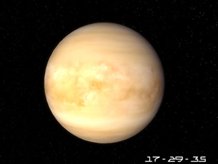
         Venus is often called Earth’s sister planet. This is where I am going to start to see if Venus would have been habitable or if it is possible to developed life down the road. For me this was one of the likely candidates. This is because of the size and the fact that it is a rocky planet as opposed to a jovian planet. The diameter of Venus is 12,104km which is very close to that of Earth which is 12,756km. There are also other similarities between the two planets these are size, mass, density and composition. However, this is all that they have in common.  Venus is closer to the sun then Earth and thus the temperature of the planet would be higher (average temperature is 462 degrees Celsius), and the days of the year are shorter.  This huge average temperature at the surface is caused by the thick and toxic atmosphere that surrounds the planet. The atmosphere is composed mainly of CO2 and sulphuric acid which would be toxic to people. There were also probes that have been sent which have not lasted long before they are destroyed by the high temperatures. One of Earth’s features that makes it unique is the presence of the inner iron core this gives Earth its magnetic field which allows protection from the solar winds. Venus does have and iron core about 3000km in radius. However, Venus rotates too slowly to generate this magnetic field. One other thing that Venus is lacking that is crucial to life is that Venus does not have any moons. Earth’s moon is large compared to other planets and it gives us our tides and helps with the precession of our Earth.
Figure obtained from: http://www.space-screensavers.com/planet-venus.html
To me there are too many factors that have to be overcome in order to make Venus habitual. There has been some talk about bringing algae into Venus’s atmosphere at these temperatures algae would survive and could possibly consume the CO2 that is in the atmosphere and convert it to O2. This is what occurred to Earth when the moon was formed, Earth became this “fireball” and the small single celled organisms were able to survive and they brought life to the planet. This I feel will not take into account some of the other factors that Venus has going against it. For example, the lack of a large moon, and what about water?  Next time I will look at Mars to see if there would be any possibility there, since there is proof of liquid ice.

Information was obtained from:
http://science.nationalgeographic.com/science/space/solar-system/venus-article/